AI Took My Time and Gave Me Work

Everybody keeps talking about how AI is supposed to save time, make money, simplify life, and help you do more with less.
Okay. Where?
Because my experience has been the complete opposite, and I’m tired of hearing the same success stories without anybody talking about what happens when this stuff goes wrong.
I spent months building my business website. Months of thinking, planning, creating, revising, and making decisions. I wasn't playing around with an idea. I was building something I intended to use.
Then I went to AI for help with a specific task.
Not a redesign. Not a fresh start. Not permission to change everything it thought needed changing. I needed help with one thing.
And somehow, work I had already done was damaged.
Now I'm sitting here dealing with the very thing I went to AI to avoid: more work.
And not the good kind, either. Not building something new. Not moving my business forward. Not making money.
Trying to recover what I already had.
Make that make sense.

Everybody talks about what AI can do. Who's talking about what it costs when it doesn't?
I'm not new to troubleshooting. I'm a tech baddie. I've been solving problems, helping people navigate systems, and figure things out for years. I understand that technology isn't perfect. I don't expect it to be.
But there's a difference between a tool making a mistake and a tool making a mistake that leaves you holding the bag.
When something goes wrong, I need more than another explanation. I need more than a list of things to try. And I certainly don't need to keep explaining what I originally asked for while the problem gets bigger.
I need the problem fixed.
That's where this experience went left.
I got responses. I got suggestions. I got explanations about what might have happened and what I could try next.
What I needed was my work back.
Those are two VERY different things.
And the more time I spent trying to get an actual resolution, the more I questioned what I was getting out of the experience in the first place.
Because if I have to spend hours correcting, checking, and trying to recover work that was already done, where exactly is the time savings?
The hidden cost is not just the mistake
The public story around AI tends to focus on best-case outcomes. Someone saved hours. Someone launched a business. Someone wrote a book. Someone created a product in a weekend. Those stories may be real, but they are not the whole economy of the tool.
The missing part is what happens when the process fails after trust has already been extended.
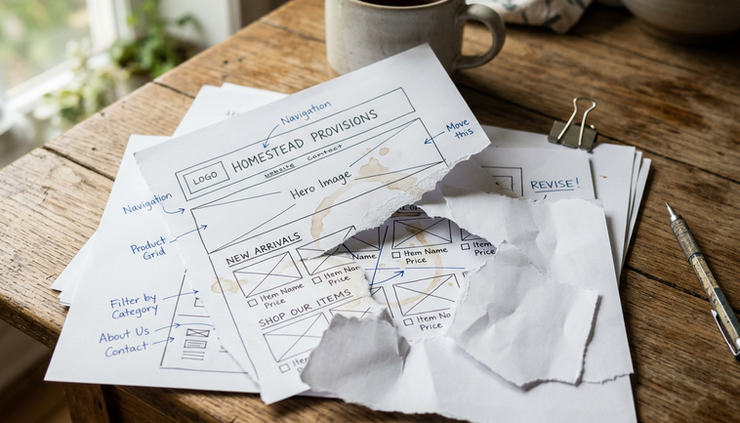
In my case, the damage was not theoretical. I had work that existed. It had value. I had invested months into it. When the AI-assisted process changed things I did not request, I was not simply disappointed. I had to shift from building to recovering.
That shift has a cost.
There is the obvious time cost. You stop moving forward. You go back through pages, settings, files, versions, content, and structure. You look for what changed. You try to separate the original problem from the new problems introduced by the attempted help.
There is the cognitive cost. You have to hold the entire system in your head again. What was the page supposed to do? What did it look like before? Which change caused which break? Is this fix safe? Is this answer reliable? What else did it touch?
There is the trust cost. Once a tool violates the scope of the request, every response after that becomes suspect. Even if it sounds correct, you cannot relax into it. You have to inspect it. You have to verify it. You have to assume the confidence may be cosmetic.
And there is the professional cost. When you build something for your business, the website is not a hobby project sitting on the side. It represents your work, your credibility, your ability to be found, understood, and paid. Damage to that asset is damage to more than a layout.
AI conversations often treat failure like an inconvenience. In real work, failure can destroy existing value.
Generating something isn't the same as getting something done
This is one of my biggest issues with how AI is presented.
AI produces something, and everybody celebrates the output.
Look! It wrote the content. It built the page. It generated the image. It gave you a plan.
Great.
But does it work?
Did it do what you actually asked? Did it leave everything else alone? Can you use the result without spending another three hours checking behind it?
Because I don't get paid for how much activity I create. I care about what I accomplish.
And I would rather have one thing done correctly than ten things generated that I now have to fix.
That should not be a controversial opinion.
I have spent years working with customers, solving technical problems, improving processes, and figuring out how to get from problem to resolution. I know the difference between somebody doing something and somebody actually handling something.
AI has a way of making those two things look the same.
A response appears. It sounds confident. There's a whole explanation behind it.
But confidence doesn't mean the problem is solved.
Sometimes all you've received is a very well written reason you're still doing the work yourself.
And somehow, the work becomes yours again
Here's the part that really gets me.
When AI makes a mess, you're the one who has to figure out what happened.
You're the one checking the work.
You're the one trying to remember what things looked like before.
You're the one deciding whether the next suggested fix is going to help or make things worse.
And you're the one who has to live with the outcome.
Meanwhile, the tool keeps giving you more things to try.
At some point, I have to ask: Am I using a tool to help me work, or am I managing a tool that has become another project?
Because that's what this started to feel like.
I went looking for assistance and ended up responsible for the original task, the unexpected changes, the troubleshooting, and the recovery.
That's not less work.
That's my work plus somebody else's mess.
And when you're trying to build a business, your time isn't some unlimited resource you can keep throwing at problems that shouldn't have existed in the first place.
Every hour I spend trying to recover something is an hour I'm not spending on the next thing.
That's time I can't get back.
I'm not interested in another explanation
One of the most frustrating things about this whole experience is how easy it is for the conversation to keep going without the problem getting resolved.
There's always another answer. Another possible cause. Another workaround. Another set of instructions.
And I can keep engaging because I want the problem fixed.
But at some point, the conversation itself becomes work.
I don't need an endless supply of responses. I need an outcome.
If my website is damaged, telling me what might have happened is not the same as restoring it. Giving me instructions to try is not the same as verifying that the repair worked.
And if you can't actually restore it, say that. Don't keep sending me through another round of troubleshooting as if another answer automatically means we're closer to a solution.
I'm a grown woman. I can handle an honest limitation.
What I have a harder time accepting is spending my time, energy, and attention chasing a result that never arrives.
That is why “AI Took My Time and Gave Me Work” is not a dramatic title to me. It is a plain description of what happened.
So, is AI really making us more productive?
Maybe for some people. Maybe for some tasks. I'm not here to tell anybody their good experience isn't real.
But mine isn't either.
And I think there's a serious gap between the way AI is marketed and what people can actually experience when they depend on it for real work.
It's easy to say AI saves hours when you're counting how quickly it generates something.
Are we counting the time spent checking it?
The time spent correcting it?
The time spent trying to undo changes nobody asked for?
The time spent explaining the same request over and over?
What about the cost when the original work is damaged and there's no quick way to get it back?
I don't see enough conversations accounting for all of that.
And I don't think we can honestly talk about productivity without including it.
Because if a tool saves me twenty minutes on one task but costs me five hours recovering from another, I need to know that before I start building my entire workflow around it.
Potential isn't the same as performance.
And a tool being capable of doing something doesn't mean it's reliable enough for me to trust it with something I've spent months building.
Maybe I'm just picky.
We need a more honest measure of productivity
If AI is going to be part of serious work, then the measure cannot be how much it can generate.
The measure has to include what it preserves.
Did it protect the user’s existing work?
Did it stay inside the requested scope?
Did it reduce the total effort, including review and correction?
Did it create a result that held up under inspection?
Did the user have meaningful recourse when something went wrong?
Those questions are less exciting than a demo. They are also more honest.
The economics of AI are not only about subscription costs or minutes saved on a single task. They include trust, attention, verification, recovery time, and the risk of damaged assets. They include the exhaustion of having to correct the tool repeatedly while the tool keeps presenting itself as helpful.
They include the moment when you stop asking, “Can this help me?” and start asking, “What will it cost me if it doesn’t?”
That is the conversation I want to have. Not hype. Not rejection. Not a performance of being impressed or offended. Just a clear look at what happens when people use these systems in real work and the outcome does not match the promise.
AI can be useful. I believe that because I have seen enough to know it can support thinking, drafting, analysis, and technical tasks when the scope is right and the risk is controlled. But potential does not cancel experience. A tool can be impressive in one context and costly in another. Both things can be true.
I don't like to lose. Especially when it's time, work or trust. And the very humble:
"Oops, my bad" AI response inspires a rage that only tech can incite.
I didn't expect perfection. I expected help with the task I asked for. I expected my existing work to be respected. I expected that if something went wrong, recovery would be treated as the priority, not as a prompt for more explanations.

Here's where I am with AI
I can't pretend AI is useless.
I'm not interested in pretending it's the answer to everything.
I'm interested in results.
If it helps me think through a problem, great.
If it helps me get a first draft together, great.
If it handles a task correctly and gives me time back, even better.
But if it creates more work than it removes, I need to be able to say that without being told I just need to learn how to use it better.
Yes, there are things users need to understand. Yes, we should verify important work. Yes, we should be careful about what we let tools change.
But users being responsible doesn't mean the tools get to escape accountability for how they perform.
I was clear about what I needed. I had existing work I wanted to protect. I wanted help with a specific task.
I did not ask for months of work to become another problem I had to solve.
And I don't think expecting that distinction to be respected is asking too much.
What bothers me most isn't simply that something went wrong. It's that I went looking for help, lost time and work in the process, and still had to figure out how to move forward.
That's a very different experience from the one we're constantly being sold.
And it's the one I want to talk about.
Not the fantasy version where every tool works perfectly and every experiment turns into income.
The real version. The one where you show up with a real problem, real responsibilities, limited time, and something you've worked hard to build.
Thank you DevTeam for Site Versions!
If I'm doing the work, checking the work, fixing the work, and cleaning up after the work, what exactly am I paying for?
That's my question.
And I would love to hear from people who have had experiences like mine, because I know I'm not the only person trying to figure out whether AI is actually making life easier or just giving us a whole new set of problems to manage.


Comments